
Published November 5, 2026
Chimney Inspection Freeport NY: What’s Wrong, Why It Happened, and What Actually Fixes It
Freeport sits about a mile from the Atlantic, and that salt air does things to masonry and metal that homeowners in inland Nassau County towns rarely see at the same pace. We’ve pulled apart chimneys on South Long Beach Road and Meadowbrook Parkway-adjacent neighborhoods where salt-driven corrosion had eaten through a damper frame in just a few seasons. A chimney inspection in Freeport, NY isn’t a formality. It’s the only reliable way to find out what the ocean climate has been doing to the one system in your house that, when it fails, can start a fire or push carbon monoxide into your living room.
What follows isn’t a checklist you can print and work through yourself on a Saturday. It’s a plain account of the real problems we find during chimney inspections in Freeport and the surrounding Nassau County communities, what causes them, and where the line sits between something a homeowner can manage and something that genuinely requires a licensed professional.
A Freeport Customer’s Wake-Up Call
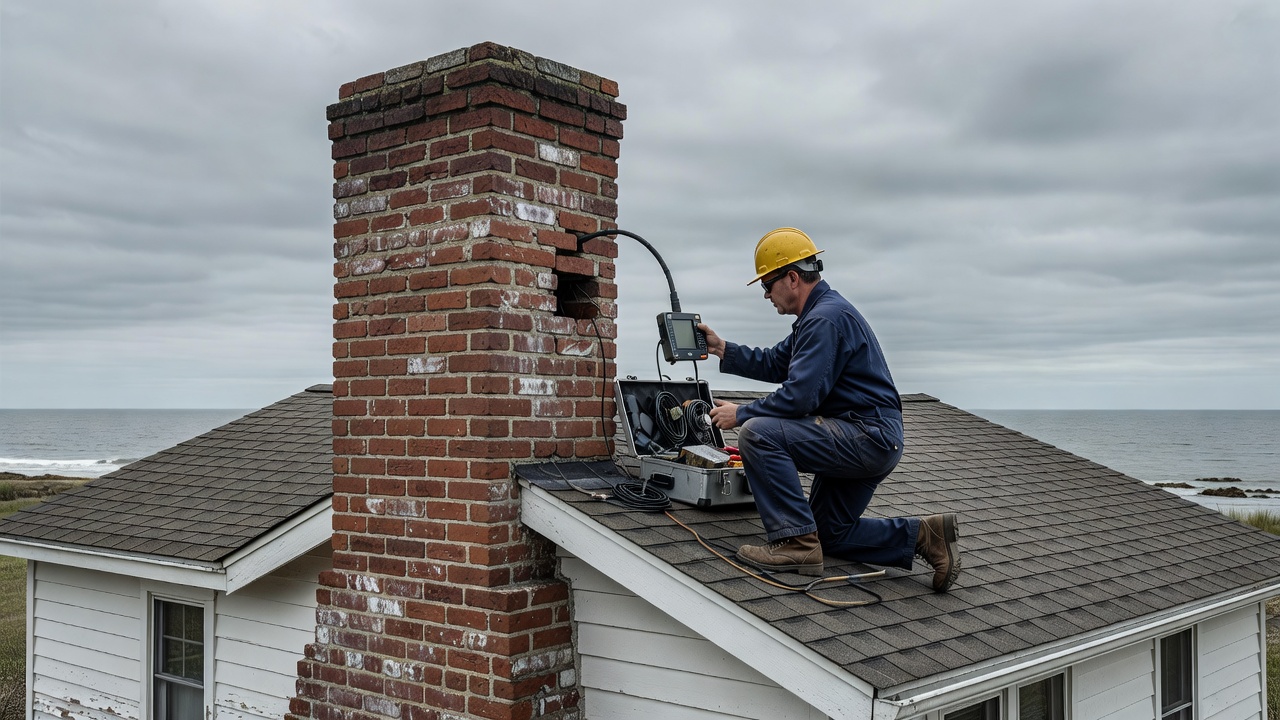
Last November, a homeowner near Buffalo Avenue in Freeport called us after noticing a faint smoke smell in an upstairs bedroom every time the fireplace ran. She’d had the flue swept two years prior and assumed it was fine. When we ran a Level II chimney inspection, we found a horizontal crack across two flue tiles about six feet above the firebox. The crack was letting combustion gases leak into a small void between the flue liner and the surrounding masonry, and from there into the wall cavity. She couldn’t have seen this from the firebox opening. No mirror, no flashlight, and certainly no camera phone on a selfie stick would have revealed it. That gap between what’s visible from the hearth and what actually exists inside the system is exactly why a professional chimney inspection in Freeport, NY matters.
Six Problems We Actually Diagnose, and How
1. Cracked or displaced flue tiles
Symptoms: smoke odor in living areas, visible white or gray staining on exterior masonry, or draft problems that get worse in cold weather. Homeowners often blame the staining on efflorescence and leave it alone.
Likely cause: The repeated thermal cycling of heating and cooling causes clay-tile liner sections to expand and contract at a different rate than the surrounding mortar. In Freeport’s coastal climate, moisture enters micro-cracks and accelerates the fracturing. We’ve also seen this in older homes in Baldwin and Oceanside where original 1950s clay-tile liners have never been replaced.
The fix: A camera scan of the full liner length is the only way to map the damage accurately. Depending on severity, the repair is either spot-repointing of joints with refractory mortar, a full stainless-steel liner installation, or a cast-in-place liner system. The homeowner cannot assess this from below, and repair is not a DIY task.
Can it be prevented? Yes, to a degree. Annual inspections catch hairline cracks before they become full fractures. The CSIA recommends at least one inspection per year, and cleaning whenever creosote deposits exceed 1/8 inch.
2. Deteriorated mortar joints in the crown and cap area
Symptoms: flaking mortar on the roof around the chimney, water stains on the ceiling near the firebox, or visible gaps between the flue tile and the crown slab.
Likely cause: The chimney crown is fully exposed to weather and in coastal Freeport, it takes freeze-thaw cycles on top of salt spray. Crowns built with standard portland cement rather than proper refractory or elastomeric material crack within a few seasons.
The fix: Minor cracks can be sealed with a flexible crown coat sealant, which a confident homeowner with roof access can sometimes apply after proper cleaning. Larger failures require the crown to be rebuilt entirely by a mason. We use a waterproof elastomeric formula rated for coastal exposure. This is one of the few repairs where a homeowner might handle a minor version, but anything requiring structural rebuilding is professional territory.
3. Creosote buildup, especially third-degree glazed deposits
Symptoms: a tar-like smell, visible black shiny residue inside the flue, or smoke that backs up into the room on cold starts.
Likely cause: Burning green wood, frequent low-temperature smoldering fires, or an oversized firebox relative to the flue diameter all contribute. The National Fire Protection Association reports that 27% of all home heating fires between 2016 and 2020 were caused by chimneys that had not been cleaned, and glazed creosote is the most dangerous form because standard brushing alone won’t remove it.
The fix: Stage-one and stage-two creosote can be removed with professional rotary tools and chemical treatments. Glazed (stage-three) deposits require a chemical rotary cleaning system or, in severe cases, liner replacement. This is not a job for over-the-counter chimney cleaning logs or a homeowner with a brush set from a hardware store in Merrick or Rockville Centre. The chemicals involved and the need for a camera verification after removal make this a professional-only job.
4. Failing or stuck damper
Symptoms: poor draw, cold drafts into the room when the fireplace isn’t in use, or a damper that won’t open or close fully.
Likely cause: In Freeport’s salt air, standard cast-iron throat dampers corrode faster than they do in inland towns like Garden City or Uniondale. The hinge mechanism seizes, or the damper plate warps from repeated heat exposure.
The fix: A seized damper can sometimes be freed and lubricated by a homeowner with patience and the right tool, but only if the throat is fully accessible and the frame is structurally sound. If the frame itself has corroded or the damper has warped, replacement is the right call. We often install top-mounted dampers on Freeport homes because they also act as a chimney cap, keeping out moisture and nesting birds.
5. Spalling and deteriorating exterior masonry
Symptoms: brick faces popping off, loose chunks of masonry on the roof or at the base of the chimney, or visible dark streaking down the exterior chimney face.
Likely cause: Water absorption followed by freezing. Brick is porous, and once moisture gets in, repeated freeze-thaw cycles blow the face off the brick. Near the water in Freeport, this process runs about twice as fast as it does in Valley Stream or Lynbrook, which are only a few miles inland.
The fix: Tuck-pointing the mortar joints addresses early-stage deterioration. Full spalling requires replacement of the damaged brick courses by a licensed mason. After repair, applying a masonry water repellent specifically rated for chimneys slows future absorption. Homeowners should not attempt to patch spalling brick with standard exterior caulk. It traps moisture behind it and makes the problem worse.
6. Improper clearances or code violations found during real estate transactions
Symptoms: a home inspector’s report flagging the chimney, or an insurance carrier requesting documentation of the chimney’s condition before writing or renewing a policy.
Likely cause: Older homes throughout Nassau County were built before modern clearance requirements under NFPA Standard 211, which governs safe distances between chimneys and combustible framing. Many Freeport homes built in the 1940s through 1960s have never had the chimney system evaluated against current standards.
The fix: A Level II chimney inspection, which includes a camera scan, is what real estate transactions require and what insurance companies accept as documentation. The New York State Department of State requires chimney sweep contractors performing liner installations to hold a home improvement contractor license, so check licensing before hiring anyone. We carry the required licenses and can provide written inspection reports for lenders and insurers.
What You Can Actually Do Yourself
Some maintenance is reasonable for a Freeport homeowner to handle. Visually checking the firebox interior for loose firebricks, testing the damper handle each fall, clearing leaves and debris from around the chimney base, and keeping a carbon monoxide detector on each floor of the house are all sensible. Burning only seasoned hardwood and keeping fires burning at a proper temperature also reduces creosote accumulation over time.
What you cannot do from the firebox opening is see the top two-thirds of the flue, assess liner integrity, verify draft performance against flue sizing, or identify the early stages of water intrusion behind the masonry. That work requires equipment and trained eyes.
Schedule Your Chimney Inspection in Freeport Before the Season Turns
Our team at Roosevelt Chimney LLC serves Freeport and the full Nassau County area, from Baldwin and Merrick on the south shore to Hempstead and Garden City further inland. If you haven’t had a chimney inspection this year, the fall booking window fills up faster than most homeowners expect. Schedule a chimney inspection or request a free estimate here, and we’ll get you on the calendar before the first cold weekend sends everyone scrambling. The U.S. Consumer Product Safety Commission reports that heating equipment fires account for roughly 25% of all home fires annually. An inspection is the most direct way to take that risk off the table.
Frequently Asked Questions
How much does a chimney inspection in Freeport, NY cost in 2026?
A standard Level I inspection typically runs $100 to $200 for a straightforward residential fireplace in the Nassau County area. A Level II inspection, which includes a camera scan of the full flue and is required for real estate transactions, generally runs $250 to $400 depending on flue length and chimney configuration. HomeAdvisor and Angi data for the New York metro area shows that complex jobs involving heavy creosote removal or additional diagnostic work can reach $600 or more. We provide written estimates before any work begins.
How often should a chimney be inspected in a coastal town like Freeport?
The CSIA recommends at least one inspection per year for any chimney that sees regular use. In Freeport and other south-shore Nassau County communities close to the Atlantic, salt air accelerates corrosion and masonry deterioration, so we recommend not letting more than one heating season go by without a professional inspection. If you burn wood regularly, that inspection should include a cleaning evaluation regardless of how the flue looks from below.
Will my homeowner’s insurance cover chimney repairs found during an inspection?
Standard homeowner’s insurance policies in New York generally do not cover chimney repairs that result from gradual deterioration or lack of maintenance, which describes most of what we find during routine inspections. Coverage may apply if damage was caused by a sudden, specific event like a lightning strike or falling tree limb. Some carriers in Nassau County require a recent inspection report as a condition of issuing or renewing a policy, particularly on older homes. We provide written Level II inspection reports that satisfy most insurance documentation requests.
Serving your area: For related services in nearby communities, see New Rochelle Chimney and Tappan Chimney Sweep.